Southwest Leaders Outline Strategic Changes, New Programs at Adjunct Faculty Convocation
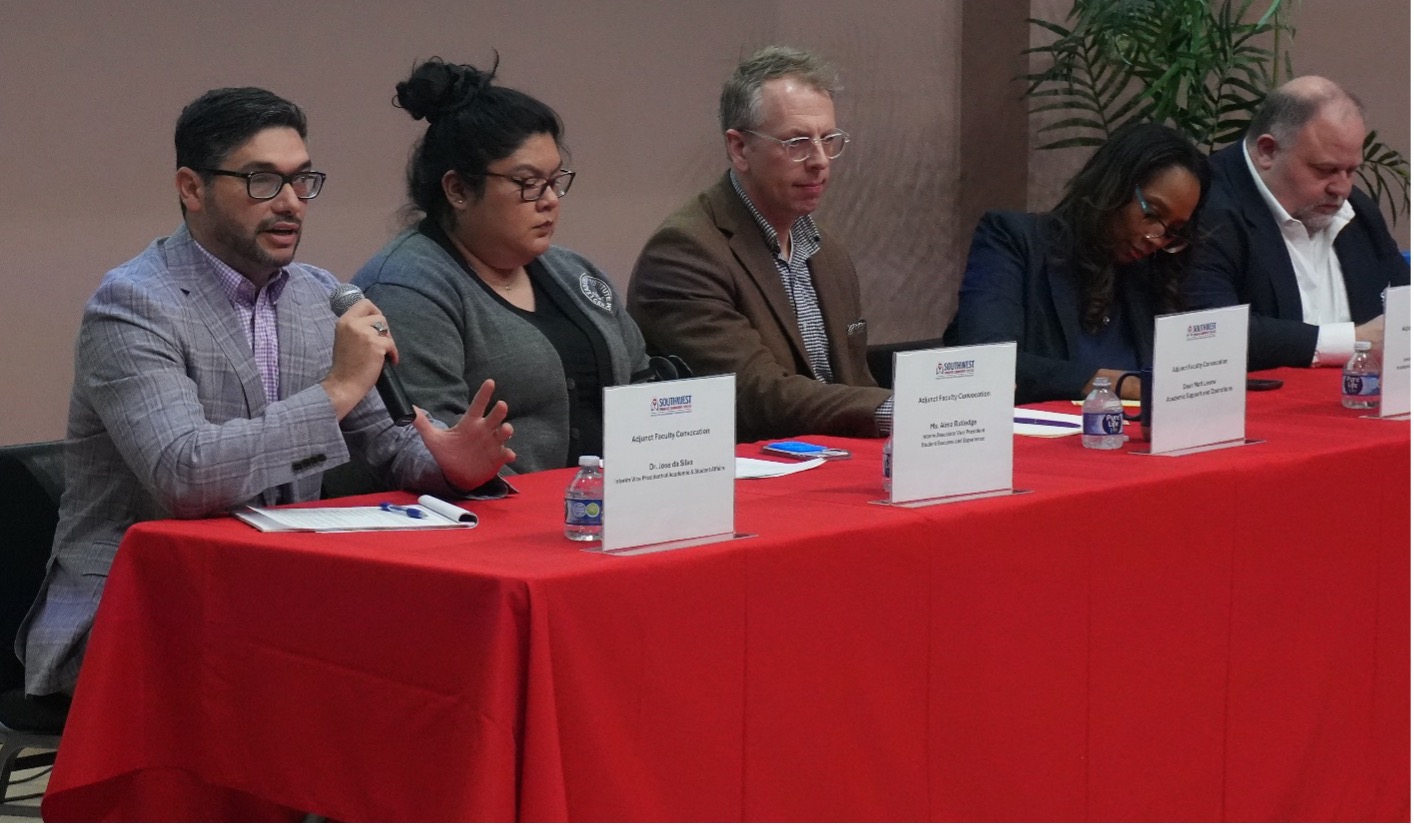
Jose da Silva outlines the college’s strategic
framework and the changes that come with Reform 3.0.
Southwest leaders shared updates on organizational changes, new academic programs, and student support initiatives during an Adjunct Faculty Convocation on Jan. 13, focusing on spring semester priorities and long-term plans under the college’s strategic framework, “Reform 3.0: Pathways to Prosperity.”
Interim Vice President for Academic and Student Affairs Jose da Silva said the college is continuing to implement a comprehensive restructuring that merges academic and student affairs under one umbrella. Consultants from the Association of Governing Boards (AGB) will conduct listening sessions with faculty, staff, and students over the next three months to recommend an optimal organizational structure. Final recommendations are expected by March.
“We want to ensure our structure aligns with our strategic goals,” da Silva said, noting that the plan will be presented to the Tennessee Board of Regents for approval in April.
Alma Rutledge, interim associate vice president for student success and experience, highlighted expanded student support services, including mental health counseling, food pantries and success coaching. A recent grant has enabled food pantries at the Macon and Union campuses to operate on a walk-in basis, eliminating the need for appointments.
Academic leaders also announced new degree programs designed to meet workforce demands. Eddie Baker, interim associate vice president for workforce, career, and continuing education, stated that the college is close to securing federal and state approval for an Associate of Applied Science in Artificial Intelligence Technology — the first of its kind in Tennessee.
“This program positions us to meet growing industry needs, especially with major tech companies opening data centers in the region,” Baker said.
In the Division of Humanities, Social Sciences, and Mathematics, Interim Associate Vice President for Academic Transfer Pathways and Learning, Sherria King said the college is seeking approval for an Entertainment Production associate in applied science degree with tracks in commercial music, TV, and film. Renovations to the theater and music facilities are scheduled to begin this spring.
Leaders also addressed changes in general education assessments, the growth of dual enrollment, and faculty development initiatives. Matthew Lexow, dean of academic support and operations, said tutoring services are expanding, with plans for embedded classroom support. The college is also piloting new tools to strengthen online instruction, which now accounts for 47 percent of classes.
Enrollment trends remain positive, officials said, with spring numbers showing an increase over last year. Budget planning for the next academic year begins in February. Faculty were encouraged to participate in departmental meetings and upcoming consultant sessions to provide input on organizational changes.
“These initiatives are about positioning Southwest for the next stage of growth,” da Silva said. “We want to ensure our students have the resources and programs they need to succeed.”